Creating Custom Power Profiles in Windows to Optimize Battery Life on Handheld Gaming PCs
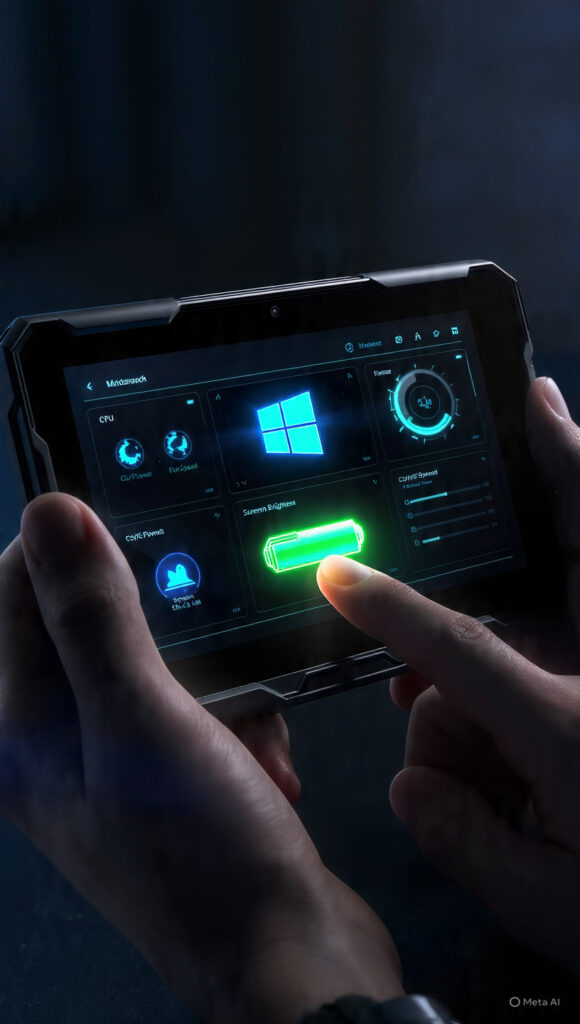
Creating Custom Power Profiles in Windows to Optimize Battery Life on Handheld Gaming PCs
Through the combination of desktop-level speed and mobility, handheld gaming PCs have revolutionised the concept of portable gaming. However, the management of battery life continues to be a persistent concern. With intense gaming loads, these devices often pack high-performance central processing units (CPUs) and graphics processing units (GPUs) in tiny chassis, which may rapidly drain batteries. There are built-in power management choices available in Windows; but, basic profiles may not strike the best balance between performance and efficiency for certain mobile gaming situations. Users have the ability to regulate the boundaries of the CPU, the performance of the graphics, the brightness of the display, and the activity in the background by establishing custom power profiles. This allows users to increase the battery life without impacting gaming. Depending on whether you are gaming, streaming, or conducting light chores, you can quickly switch between high-performance and energy-saving modes with the help of custom profiles. In order to comprehend the process of configuring these settings, it is necessary to have knowledge of the power management tools available in Windows, the behaviour of hardware, and the distinctions that exist between performance and battery economy. When you use a methodical approach, you can assure that your portable gaming computer will provide longer sessions without wasting any needless energy.
Acquiring Knowledge about Windows Power Management and Default Profile configurations
The default power plans that come with Windows are commonly referred to as “Balanced,” “High Performance,” and “Power Saver.” Each of these power plans determines how the system handles the utilisation of the central processing unit (CPU), display brightness, sleep settings, and background programs. When it comes to portable gaming computers, the Balanced profile often prioritises efficiency but may slow down gaming performance. On the other hand, the High Performance option maximises the output of the CPU and GPU but at the expense of the battery life. Although Power Saver restricts system resources in an aggressive manner in order to extend runtime, this might lead to a decrease in gaming responsiveness. Prior to the creation of custom profiles, it is essential to have a solid understanding of the parameters that are behind these basic plans. The ability to make alterations that are guided by knowledge of how Windows dynamically alters processor states, display output, and peripheral activities enables you to make improvements.
Getting Access to and Making Changes to the Advanced Power Settings
The advanced power settings in Windows may be adjusted to the user’s preferences, allowing for more precise performance customisation. The Control Panel or the Settings app may be used to access these settings, which allow for modifications to be made regarding the minimum and maximum states of the CPU, cooling policies, and the management of power for USB or PCIe. It is possible to minimise heat and power consumption on gaming personal computers by lowering the maximum CPU states to slightly below peak. This allows for a substantial reduction in performance. Adjusting the display and graphics settings may also help preserve battery life by reducing the brightness of the display or reducing the speed of the graphics processing unit in situations that are less demanding. Adjusting these sophisticated settings to perfection is necessary in order to create a personalised profile that maximises productivity while maintaining the quality of the gaming experience.
Managing the behaviour of the central processing unit and graphics processing unit for optimal battery life
Processing and graphics demands are the key factors that contribute to the draining of batteries in mobile personal computers. During games, limiting the number of CPU cores, lowering the maximum clock rates, or changing the cooling policy to a passive mode are all ways to decrease the amount of energy that is used. altering the performance of integrated graphics processing units (GPUs) or hybrid graphics setups by altering the power settings or using tools that are particular to the vendor guarantees that graphics-intensive programs do not use electricity that is not required. It is also possible to take use of dynamic GPU switching depending on workload in some mobile gaming PCs, which may be utilised in the creation of bespoke profiles. The frame rates are maintained while the battery duration is increased thanks to these modifications, which establish a compromise between the two.
Configuring Display Settings and the Power Consumption of Peripheral Devices
On mobile devices, the display is often the component that consumes the most battery power. Screen brightness, adaptive brightness behaviour, and refresh rates may all be adjusted via the use of custom power profiles, which allows for energy conservation without compromising the clarity of gaming. A further method for preventing the loss of energy is to exercise control over the power consumption of peripheral devices, such as controllers, network adapters, and USB-connected devices. The background draw may be reduced by turning off ports that are not being utilised or by activating selective suspend for peripherals. It is possible to extend the amount of time that passes between charges by properly customising the display and peripheral settings. This will increase the overall efficacy of your custom power profile.
Switching between profiles in an automated manner for various use cases
It is possible to make smooth transitions between performance and efficiency modes thanks to Windows’ support for automated profile switching, which may be accomplished using battery thresholds or additional utilities. For instance, you can set up a profile for high-performance gaming while the device is plugged in, and another profile for play that is more efficient with the battery when the device is disconnected. Companion software that connects with Windows power plans is also available on certain portable personal computers. This software allows for dynamic switching determined by activity. By automating this process, you may decrease the amount of human intervention required and guarantee that your gadget functions at its best under every circumstance. Those mobile gamers who regularly transition between charged and unplugged circumstances may find this versatility to be very beneficial.
The impact of applications on the battery is being monitored and adjusted while
The requirements that are placed on hardware by various games and programs are not uniform. Using the tools that Windows provides for monitoring battery consumption, you are able to detect applications that consume an excessive amount of energy and alter the priority of those apps in custom profiles. Increasing energy economy may be accomplished by reducing the amount of background activity, limiting CPU affinity, or modifying graphics settings for each individual program. The ability to fine-grained management for high-demand games is made possible by the fact that some mobile gaming PCs allow application-specific power profiles. Regular monitoring enables continual refinement, which guarantees that every profile achieves the highest possible level of efficiency without sacrificing performance in the areas that are most important.
Evaluation, Improvement, and Storage of Individualised Profiles
It is necessary to do iterative testing in order to assess both performance and the impact on the battery in order to create an efficient power profile. The feedback that is provided by monitoring frame rates, thermals, and runtime is to determine whether or not alterations achieve the ideal balance. In order to get the best possible outcomes, it is necessary to fine-tune variables such as the processor states, cooling policies, and display characteristics. Once the requirements have been met, storing the profile with a name that is descriptive enables simple access for usage in the future. Additionally, it is possible to export and exchange custom profiles across many devices, which simplifies the setting process for various portable PCs. One way to guarantee that your portable gaming experience is both high-performing and energy-efficient is to have a profile that has been well tested and preserved.
Establishing Habits That Will Ensure Long-Term Efficiency for Handheld Gaming
The most efficient way to implement custom power profiles is to include them into a more comprehensive efficiency approach. Among them are the management of background operations, the optimisation of gaming settings, the constant updating of software, and the maintenance of the health of the battery. The longevity of a battery may be increased by being aware of peak performance times and by practicing effective charging procedures. The development of routines for the use of profiles guarantees that your portable gaming computer will continually provide the best balance between battery consumption and performance capabilities. In the long run, the portability and lifetime of your device may be maximised by combining technical settings with practical use tactics.