Recovering Clipped Highlights in Overexposed Skies Using the Camera Raw Filter’s Masking Controls
Recovering Clipped Highlights in Overexposed Skies Using the Camera Raw Filter’s Masking Controls
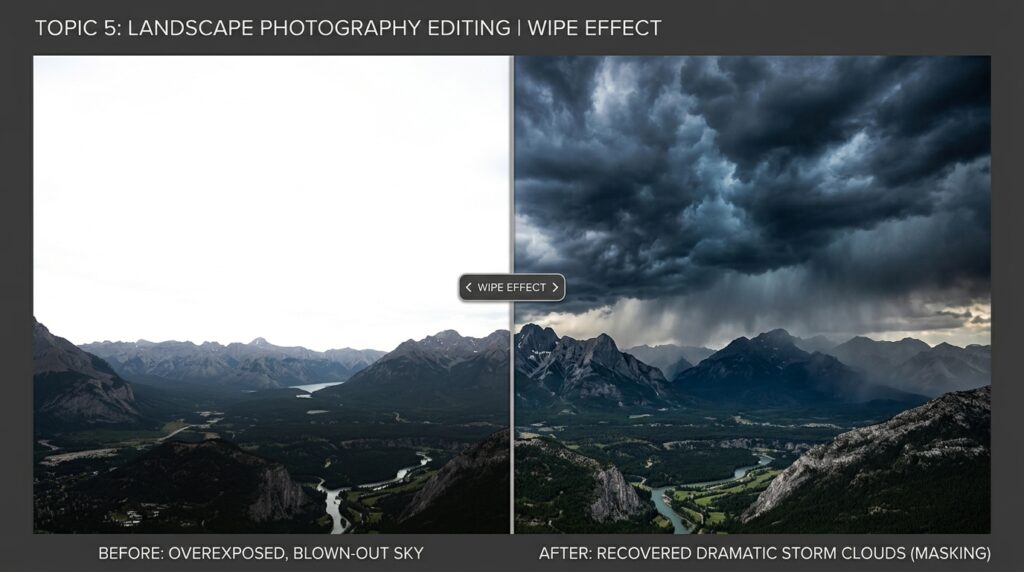
One of the most frequent difficulties that photographers face during the post-processing stage is dealing with overexposed sky. Incorrect exposure settings, bright sunshine, and situations with a high contrast may easily result in clipped highlights, which are characterized by the loss of key details in clouds and atmospheric textures. Once highlights seem to be fully white, it becomes substantially more difficult to reconstruct a sky that appears to be natural. The good news is that contemporary editing tools provide sophisticated options for restoring tonal balance without affecting the overall quality of the picture. The masking parameters of the Camera Raw Filter provide editors with strong non-destructive methods that enable them to target certain regions of an image with surprising accuracy. Photographers are often able to restore crucial information from exposures that seem to be worthless by combining highlight recovery changes with selective masking procedures. By gaining an understanding of how to make good use of these sophisticated parameters, one may generate landscapes, architecture shots, and outdoor portraits that are balanced and keep both visual reality and professional quality.
Recognizing the Importance of Clipped Highlights in Sky Photography
The term “clipped highlights” refers to the phenomenon that occurs when high-contrast areas of a picture surpass the capacity of the camera sensor to record tonal information. With regard to photography of the sky, this often takes the form of featureless white expanses in which cloud features and color gradations ought to be present. It is common for situations with a high dynamic range to push exposure limitations beyond what a single shot can reliably capture. This is especially true during circumstances such as noon sunshine or dawn. There is a possibility that part of the highlight information will be lost forever; nevertheless, many images also include recoverable data that is concealed inside highlights. For the purpose of designing an efficient editing approach, it is vital to be aware of the distinction between highlights that may be partly recovered and sections that have been entirely cut. An accurate evaluation enables photographers to have expectations that are in line with reality while the recuperation process is taking place.
An Investigation into the Capabilities of the Camera Raw Filter for Recovery
During the post-processing stage, the Camera Raw Filter provides a complete array of tools for adjusting tonal values, with the goal of achieving the highest possible picture quality. These settings, in contrast to the standard exposure adjustments, allow for the focused handling of highlights, shadows, whites, and the overall dynamic range. To restore delicate transitions inside bright regions, the highlight recovery routines perform an analysis of the picture data that is available. These modifications, when paired with methods that are not destructive, make it possible for editors to experiment with different correction strengths without permanently affecting the original file. The versatility of Camera Raw makes it an essential resource for photographers who are looking to enhance exposures that are difficult to achieve while maintaining natural tone relationships across the picture.
Making Adjustments to the Sky in a Targeted Manner Using Masking Controls
Masking controls allows for the isolation of adjustments to particular picture areas, which results in a considerable improvement in highlight recovery. Through the use of masks, editors are able to concentrate just on overexposed sky while safeguarding foreground objects. This is in contrast to the practice of making global modifications that include the whole shot. When it comes to landscapes, gradient masks are especially useful since they correlate neatly with shifts in the horizon. More sophisticated masking techniques have the ability to automatically recognize sky based on the tonal and color properties of the image. This chosen technique reduces the likelihood of undesirable side effects, such as individuals that are darkened or contrast changes that are not natural. Through the use of precision masking, it is possible to guarantee that highlight recovery attempts increase sky detail without affecting the overall composition’s equilibrium level.
Keeping a Healthy Balance Between Highlight Recovery and Natural Appearance
In spite of the fact that recovering lost information is often desired, excessive restoration might generate results that are unrealistic and lower the quality of the photographed picture. Alterations to the highlights may result in the introduction of gray tones into clouds, a reduction in contrast, or the creation of skies that are flat and lifeless. For editing to be successful, it is necessary to strike a balance between technical recovery and visual realism. In most cases, subtle modifications are able to maintain the natural connection that exists between brilliant highlights and the tonal values that are around them. It is the responsibility of the editors to determine if the recovered features contribute to the desired mood and ambiance of the shot. Maintaining a genuine look helps to guarantee that the finished picture continues to be visually attractive while avoiding evident evidence of over-processing, which may be distracting to viewers.
Administration of Exposure and Adjustments to the White Point
When paired with careful exposure and white point adjustments, highlight recovery is typically the most effective in its application. By lowering the total exposure without discrimination, it is possible to excessively darken the whole picture, while making alterations using targeted adjustments helps to preserve greater tonal separation. Controls for the white point have an effect on the areas of the picture that are the brightest, and they contribute to the establishment of an optimal balance between the preservation of detail and the maintenance of contrast. When these parameters are fine-tuned inside masked regions, editors are able to adjust the brightness of the sky separately from the brightness of the foreground items. It is possible to achieve smoother tonal transitions and increase the overall efficacy of highlight restoration attempts by making strategic use of modifications relating to exposure.
Improving the Detail of Clouds Through the Use of Localized Contrast
The process of recovering highlight detail often shows delicate cloud forms that would be ideal for further refinement. It is possible to highlight texture and depth inside restored sky sections by the use of localized contrast modifications, which do this without producing an unnatural look. To enhance visual appeal while maintaining the natural qualities of atmospheric elements, careful adjustment of tonal separation is of utmost importance. It is essential to maintain moderation, since excessive augmentation might result in the appearance of halos or structures that are overdone. To achieve more accuracy and to avoid unwanted modifications in other parts of the picture, it is possible to selectively apply these enhancements by using masking settings. Photographing landscapes with improved cloud clarity results in photographs that are more dynamic and interesting.
In the process of highlight recovery, addressing color shifts
Adjustments to the highlights may occasionally have an effect on the color balance, especially in instances when the sky has faint blue gradients or warm sunset tones. An excessive amount of recovery may result in a decrease in color saturation or the introduction of undesirable shifts that impede realism. The act of editing helps to preserve consistency and authenticity by monitoring color relationships throughout the process. Through the use of targeted color modifications inside masked parts, it is possible to restore natural colors without impacting other portions of the whole picture. In order to guarantee that recovered sky have their structural detail as well as their exact atmospheric properties, it is necessary to evaluate the interplay between tonal adjustments and color integrity. Putting in the effort to regulate colors results in an overall improvement in the quality of the final picture.
The Process of Putting in Place a Non-Destructive Editing Workflow
When it comes to conducting complicated highlight recovery tweaks, non-destructive editing procedures are absolutely necessary. Modifications made to the Camera Raw Filter are continuously modifiable during the editing process, enabling photographers to review selections whenever they are required to do so. Additional flexibility is provided by layer-based procedures, which enable opacity modifications and selected tweaks to be made after initial repairs have been performed. Using this method allows for testing to take place while maintaining the integrity of the original picture data. Non-destructive procedures are particularly useful in situations when the creative direction or input from the customer changes while the production is in progress. In addition to facilitating more effective post-processing procedures, maintaining editable modifications guarantees a higher level of control.
In order to get consistent results, the development of dependable techniques
The recovery of clipped highlights in sky that have been overexposed calls for a judicious blend of technical expertise and artistic judgment. The masking parameters of the Camera Raw Filter provide strong capabilities that allow for the selective restoration of information while maintaining the integrity of the overall composition. By striking a balance between highlight recovery, exposure refinement, localized contrast improvements, and careful color control, photographers are able to turn difficult exposures into photographs that are visually attractive. Implementing editing techniques that do not cause damage to the document further enhances the flexibility of the workflow and promotes continuous improvement. By gaining expertise with these approaches, photographers are able to create dependable tactics for dealing with challenging lighting settings and regularly generating photographs of professional quality that have balanced sky that seem natural.