How to Use the Updated Photoshop “Remove Tool” to Automatically Delete Power Lines and Small Distractions
How to Use the Updated Photoshop “Remove Tool” to Automatically Delete Power Lines and Small Distractions
The revised Remove Tool in Photoshop is intended to ease one of the most time-consuming aspects of picture editing, which is the process of removing undesired items from photographs. If an image has power lines, wires, dust spots, or other tiny background distractions, the visual quality of the shot might be greatly diminished. This is particularly true in landscape photography, architectural photography, and urban photography. This new Remove Tool, which is powered by artificial intelligence, does an intelligent analysis of the surrounding material and automatically reconstructs any parts that are missing. This enables photographers to obtain clean, professional results without having to resort to complicated manual retouching approaches.
Acquiring Knowledge about the Operation of the Remove Tool
In order to determine what should be hidden behind the item that has been chosen, the Remove Tool makes use of artificial intelligence. Instead of just blurring or copying surrounding pixels, it analyzes the textures, lighting, and patterns across the picture in order to create replacements that are an accurate representation of the original. Because of this, it is especially useful for illuminating thin objects, such as electricity lines or cables, which often traverse complicated backdrops, like as the sky, trees, or buildings. The tool exhibits dynamic adaptation, allowing it to maintain natural gradients and edges while simultaneously deleting undesirable pieces in a seamless manner.
Making the Image Ready for the Best Possible Results
Before utilizing the Remove Tool, it is essential to work on a picture that is free of any imperfections and of a good quality. Converting the base layer into a Smart Object enables for adjustments to be made in the event that the AI output is not flawless. This assures that the editing process is non-destructive. It is helpful to discover all of the things that need to be removed by zooming in to evaluate regions that contain distractions. To further increase the artificial intelligence’s capacity to produce realistic background material, noise should be cleaned up and exposure should be corrected beforehand.
Power Lines Can Be Removed Using the Remove Tool
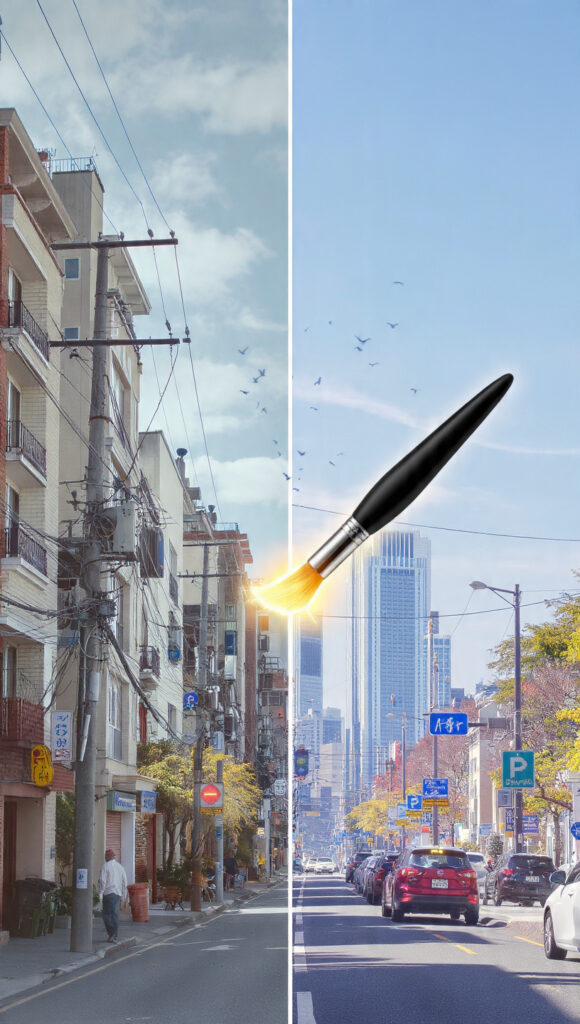
Selecting the Remove Tool and painting over the lines with a light brush is all that is required to effectively remove power lines. Photoshop will automatically identify the item and replace it with the textures that are in the surrounding area. For the purpose of organically reconstructing the missing region, the artificial intelligence analyzes sky gradients, tree patterns, or building surfaces. This procedure works very well even when lines intersect intricate or detailed areas, which eliminates the requirement for clone stamping, which is a time-consuming step previously required.
The Elimination of Minor Distractions in the Background
In addition to being excellent for removing large distractions, the Remove Tool is also useful for removing smaller distractions such as dust spots, sensor marks, or undesired items in the background. The quality of the picture may suffer as a result of these aspects, which might gently divert the viewer’s attention. Using Photoshop, you can rapidly make replacements that are clean and blended by just brushing over them. Artificial intelligence guarantees that lighting and texture are maintained at a constant level, which makes the modifications almost undetectable even when seen in close detail.
Using Layer Masks to further refine the results
Even though the Remove Tool has a high degree of accuracy, there are certain difficult places that could need some small adjustments. Through the use of layer masks, it is possible to carefully mix the material that was created by AI with the original picture. Additionally, this allows for exact control over transitions and edges, which is particularly useful in regions that have tiny textures such as foliage or patterned surfaces. In order to get a natural-looking end product that is devoid of artifacts, masking is an essential step.
Dealing with Complicated Scenes and Patterns That Are Repeated
It is possible that the artificial intelligence may sometimes generate tiny discrepancies in images that have repetitive patterns, such as fences, roofs, or architectural elements. For situations like this, increasing the number of times you use the Remove Tool while making smaller brush strokes can enhance your accuracy. Through each iteration, Photoshop acquires new knowledge and improves its reconstruction. This, in conjunction with manual touch-ups using basic retouching tools, guarantees a level of accuracy that is comparable to that of a professional in highly detailed photographs.
Confirming the Edits at the Highest Resolution
Following the elimination of any potential distractions, it is necessary to examine the picture in its full resolution. Detecting any strange textures, repeating patterns, or lighting mismatches may be made easier by zooming closer on the subject. The success of the cleaning may be determined by comparing the altered picture to the original. This quality control phase guarantees that the retouching will not be apparent to the viewer and will preserve the authenticity of the original scene.
It is possible to save and export clean images.
As soon as you are pleased with the modifications, save the file as a layered document so that all of the changes are preserved. It is possible to export high-resolution copies for usage in print or digital media while preserving the highest possible picture quality. The organization of cleaned images using explicit naming standards makes it simpler to make adjustments in the future and ensures that procedures are consistent throughout more than one project. The metamorphosis from a crowded picture to a refined and professional shot is finished with this last step.
Guidelines for the Most Effective Use of the Remove Tool
Make use of gentle brushes and refrain from eliminating particularly big things in a single pass if you want to attain the finest possible outcomes. It is important to work methodically, carefully examine the subtleties, and where appropriate, combine the elimination of AI with delicate hand modification. It is possible to get consistent and dependable outcomes by beginning with high-quality source photos and by sustaining procedures that are non-destructive all the way through. Through the use of these best practices, the revised Remove Tool may be transformed into a highly effective and time-saving component of any professional editing process.